Star Trail Calculator
Enter your lens and camera above and this star trail calculator shows the longest shutter speed you can use before stars start to trail, worked out two ways: the classic 500 Rule and the more precise NPF Rule. Results update as you type, and nothing you enter leaves your browser.
How to use the star trail calculator
There is no calculate button. Set the controls and both exposure times change with every edit:
- Focal length: the lens setting in millimeters, as printed on the lens (not the 35 mm equivalent).
- Aperture: the f-stop you plan to shoot at, such as 2.8.
- Sensor format: Full Frame, APS-C, Micro 4/3 or 1-inch.
- Megapixels: your camera's resolution, used to estimate the pixel pitch.
The two cards show the 500 Rule and NPF Rule exposure in seconds, rounded to one decimal. Choose the NPF figure for pinpoint stars.
500 Rule = 20.8 s, NPF Rule = 11.6 s
50 mm, f/1.8, APS-C, 24 MP
500 Rule = 6.7 s, NPF Rule = 3.7 s
500 Rule vs NPF Rule: which shutter speed to trust
The 500 Rule divides 500 by your focal length multiplied by the crop factor. It is simple and ignores everything else. The NPF Rule is (35 × aperture + 30 × pixel pitch) ÷ focal length, so a wider aperture or smaller pixels shorten the time. It uses the real focal length printed on the lens, with no crop factor applied. On a modern high-resolution camera the NPF time is usually well below the 500 Rule time, and it is the one to follow if you want stars that stay round when you zoom in.
How the 500 Rule works on crop sensors
A smaller sensor magnifies the sky, so trails show up sooner. The calculator multiplies your focal length by 1.5 for APS-C, 2.0 for Micro 4/3 and 2.7 for 1-inch, and leaves Full Frame at 1.0. Canon APS-C bodies are really 1.6, so their true limit is a little shorter than shown.
What pixel pitch is and when to enter it
Pixel pitch is the size of one pixel on the sensor, in micrometers (µm). By default the calculator estimates it from the megapixels and the sensor format, assuming a 3:2 sensor, so it is a close estimate rather than an exact figure. If your camera's specification lists the exact figure, switch on Advanced and type it in the Pixel pitch box; it then replaces the estimate.
Tips for sharp stars
- Round the result down to the nearest shutter speed your camera offers.
- Open the aperture and raise the ISO rather than lengthening the exposure.
- A wider lens allows a longer exposure, since the sky moves less across the frame.
- Stars near the celestial poles move slowly, so they tolerate longer exposures.
FAQ
What is the NPF rule in astrophotography?
The NPF rule is a shutter-speed formula that accounts for your aperture, your sensor's pixel pitch and your focal length: (35 × aperture + 30 × pixel pitch) ÷ focal length, in seconds. It keeps stars as points at the pixel level, so it is stricter than the 500 Rule on high-resolution cameras and wide-open lenses.
NPF rule vs 500 rule: which is more accurate?
The NPF rule, because it uses your actual pixel size and aperture, while the 500 Rule only looks at focal length and crop factor. The 500 Rule is a quick general guideline from the film era and tends to allow trails on modern high-megapixel sensors. Use the NPF figure when you want pinpoint stars or plan to print large.
How long can I expose before stars start to trail?
Enter your lens and camera above: the NPF Rule card is the longest exposure that keeps stars as points, and the 500 Rule card is the looser limit where trails begin to show at normal viewing size. For a 24 mm f/2.8 lens on a 24 MP full frame camera that is about 11.6 s and 20.8 s.
Does the 500 rule work on a crop sensor?
Yes, once you multiply the focal length by the crop factor: 500 ÷ (focal length × crop factor). This calculator does that for you with 1.5 for APS-C, 2.0 for Micro 4/3 and 2.7 for 1-inch sensors. Real crop factors vary slightly, for example 1.6 on Canon APS-C, so treat the result as a guide.
What shutter speed should I use for stars?
Use the result of the NPF Rule as your upper limit, then round down to a speed your camera offers. Typical values run from about 5 to 25 seconds depending on the lens: shorter for long focal lengths and high-resolution sensors, longer for wide lenses. Raise the ISO rather than the exposure time if the picture is too dark.
How do I find my camera's pixel pitch?
Pixel pitch is the width of one pixel on the sensor in micrometers (µm). The camera maker usually lists it in the specifications, or you can divide the sensor width in millimeters by the image width in pixels and multiply by 1,000. If you do not know it, leave Advanced off and the calculator estimates it from the megapixels and sensor format.
How do I avoid star trails?
Keep the exposure at or below the NPF Rule figure, use a wider lens or a faster aperture so you can shorten the exposure, and raise the ISO to compensate. Shooting toward the celestial poles also helps, because stars there move slowly across the frame. A tripod keeps the camera still, but only a tracker stops the sky's own motion.
Recommended
-
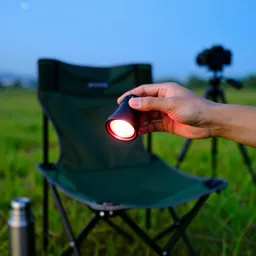 Celestron Red LED Astronomy Headlamp
Check settings in the dark without ruining your night vision.
-
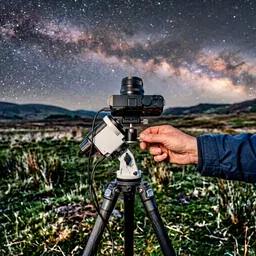 Sky-Watcher Star Adventurer 2i Pro Pack
Tracks the sky so exposures run far past the 500 Rule limit.
-
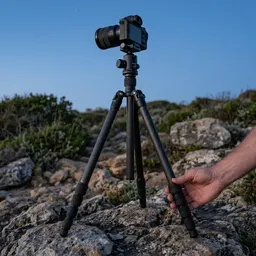 Neewer Carbon Fiber Travel Tripod
A steady tripod keeps stars sharp through a long exposure.
Helps keep the tools free. ✨
Images are for illustration only. As an Amazon Associate I earn from qualifying purchases.